
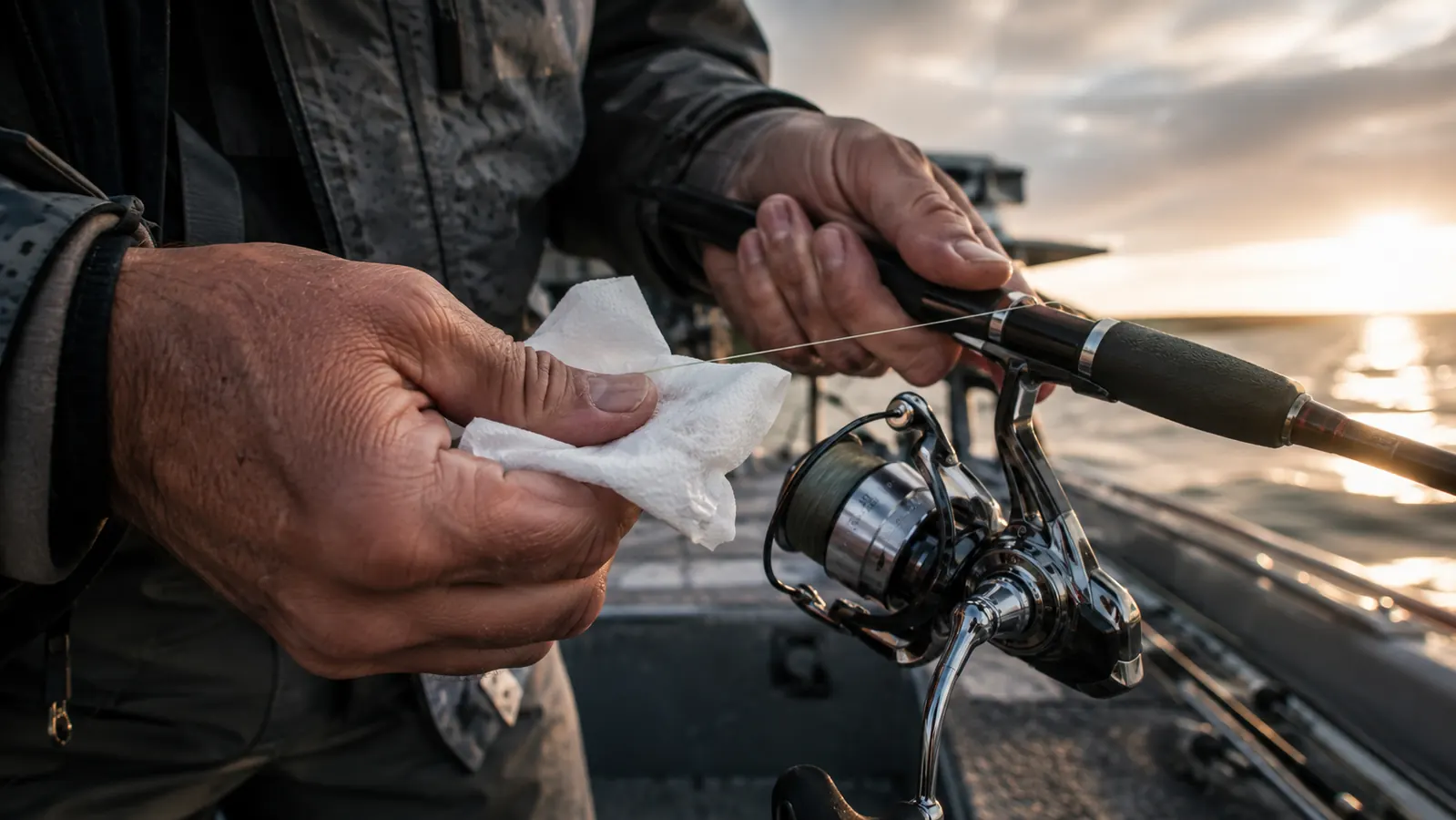
Every wind knot I picked out of a reel this season came from the same two mistakes, and neither one happened on the water. The line was loaded with too little tension, and the bulk spool was feeding it on in the wrong direction. Braid punishes both the way monofilament never did for me. Mono has memory and stretch, so it can forgive an afternoon of sloppy spooling. Braid is round, slick, and zero stretch, so every twist it takes while it is going onto the spool sits there and waits for the first good cast of the day to come out as a tangle. I have cut three spools of braid out of reels with a pocketknife because I was in a hurry to fish.
The fix was not a fancy spooling station, and it cost nothing I did not already own. It is a pencil, a wet paper towel, and about five minutes per reel. It is the same process I used to put RIKIMARU braid on every reel I keep in the boat this season. Ten-pound on the light spinning rod I hand to company, thirty-pound on both baitcasters. Three spools, a full season of weekend trips behind the boat, and zero wind knots, including the afternoon with the canopy up and a wind quartering over the stern. Here is the exact process, in the order I do it, so you can skip the season of knife work I put in first.
The Braid I Spooled Every Reel With This Season
RIKIMARU braided line is extra thin for its rating and zero stretch, and it lands in spools from 327 to 1,094 yards at a price that makes a redo cheap. Spool it right once and it casts all season.
Amazon Check Today's Price on Amazon →Five Steps to a Twist-Free Spool
Step 1: Match the Line to the Reel, Not the Reel to the Line
The reel decides the pound test, not the rod and not the fish you are imagining for next weekend. Look at the side of the reel body and you will find the line rating printed right in the plastic. My 2500-class spinning reel is rated for 10- to 15-pound line, and both baitcasters are rated for 30. I run 15 on the spinning outfit and 30 on the casting reels, and I did not go any lighter just because the diameter is thin. Cover, docks, and the edge of a weed bed will test the outside few feet of any line, and the heavier test costs you almost nothing in casting.
The part of this step worth believing is the diameter. RIKIMARU's own listing says extra thin diameter, and it is honest: a 15-pound braid lays down the way an 8-pound mono looks, which means the same spool holds noticeably more line than the mono yardage marked on your reel suggests. That extra capacity shows up as real distance on the cast and as forgiveness when a beginner is thumbing a baitcaster for the first time. You are not buying lighter line by picking a thin braid. You are buying more line in the same place.
If you are stuck between two adjacent tests on the shelf, take the heavier one and do not second-guess it. Abrasion is what kills braid, and it is the main reason the RIKIMARU spool carries a 4.4 average across more than six thousand Amazon reviews. Rocks and reeds wear on the outside few feet first, and a step up in test buys you trips before you have to cut back and re-rig. One spare spool in the glove box means you are never limping along on the last fifty yards to save money.
Step 2: Backing First. This Is the Rule That Stops the Slip
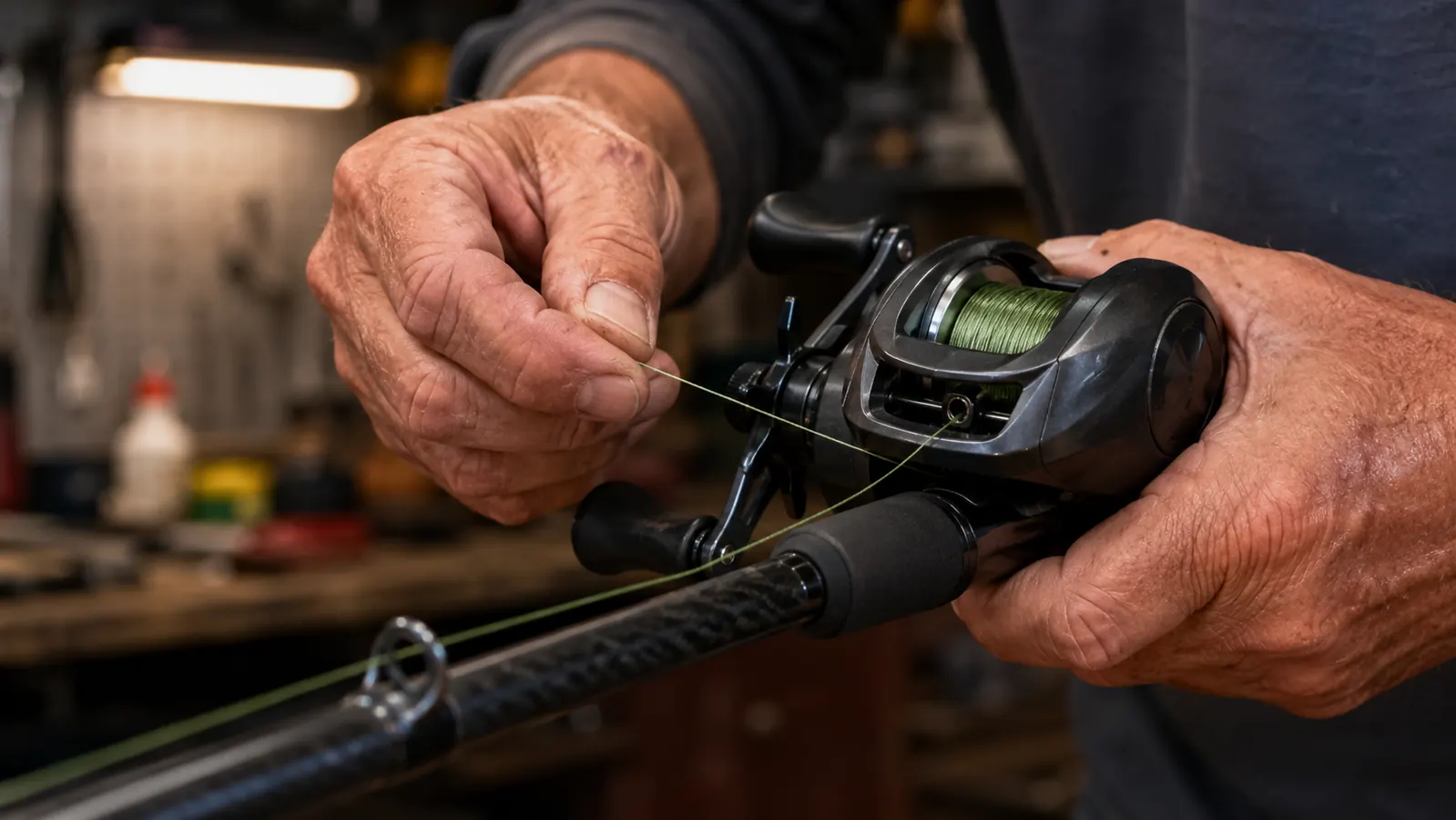
Braid is slick. That one fact is why a brand new spool filled with nothing but braid can betray you: under a hard run, the whole load can slip around the arbor and spin instead of letting the drag do the work. When the load spins, the line stops coming off the reel and starts coming off the spool knot, and your drag becomes decoration on a fish you cannot stop. Mono backing is the fix, because mono grips the arbor and gives the braid an edge to bite into.
The sequence is short. Tie the mono to the arbor with an arbor knot, fill the spool a quarter to a third of the way, then join the braid to the mono with a double uni or an Albright. Wet both knots, snug them slowly, and pull hard enough that you trust them, then trim the tag ends to a whisker. Backing knots never see your casts, but they do see a hooked fish, so do not get cheap there. Ten-pound backing under a 15-pound main line, or 20 under 30, is about right.
If you will not run backing at all, run a wrap of electrical tape around the arbor first so the braid has a texture to grip. I have done that on a loaner reel and it holds, but the tape leaves residue on the arbor and you are still filling the bottom half of the spool with the most expensive line you own. Backing is a fraction of the price of the same yardage in braid, and this is the rule that keeps a good fish from spinning your spool at the worst possible moment.
Step 3: Get the Spool Feeding the Right Direction
Here is the whole physics lesson in one sentence: the reel lays the line on with a turn, so the line coming off the bulk spool has to be turning the same way, and if it is not, you bank one twist for every revolution of the rotor. Spool a hundred yards the wrong direction and you have banked a thousand twists, all of them waiting to surface as a loop on the first cast of the morning.
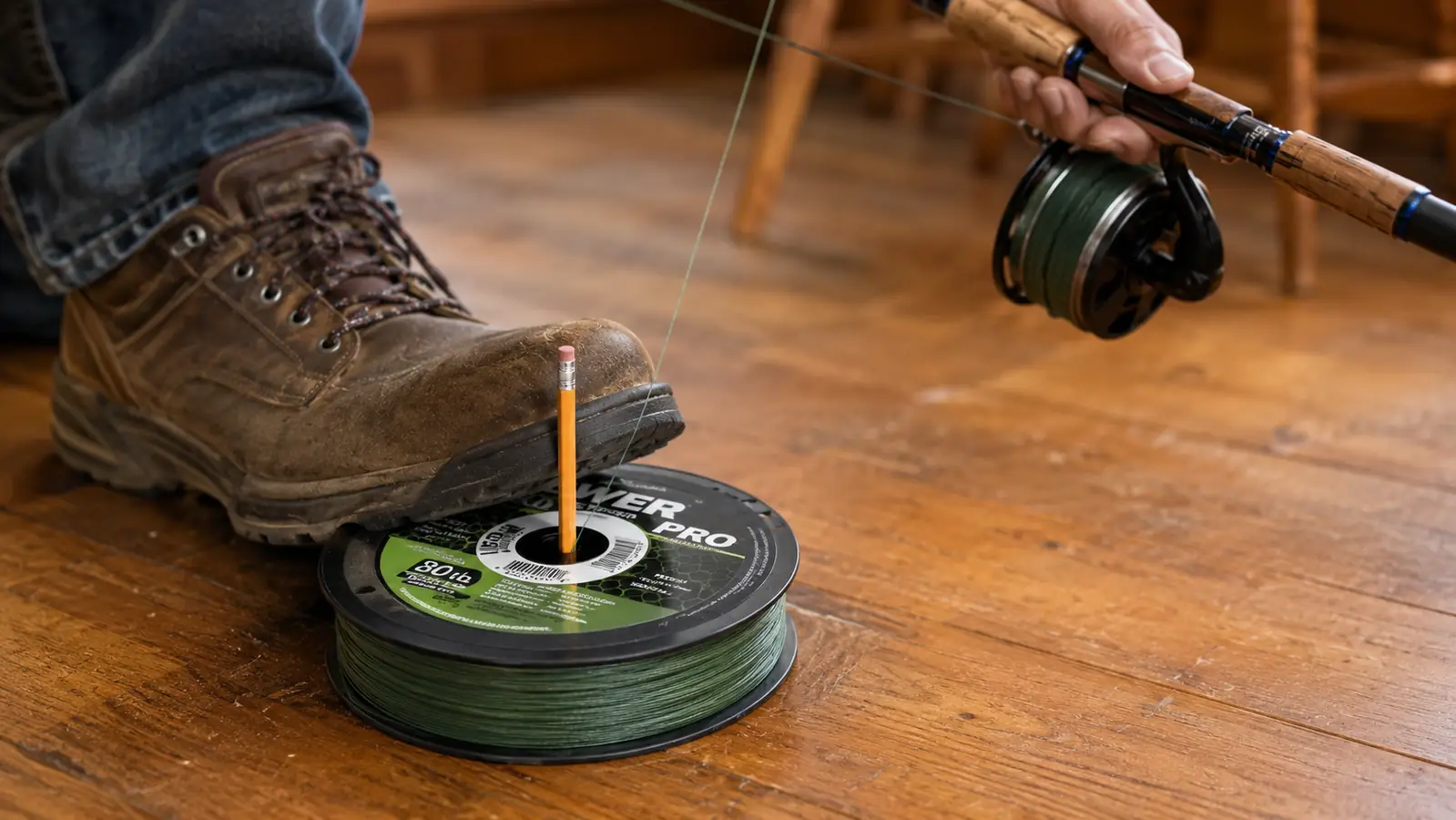
The mechanical way to get the direction right takes a pencil. Pass it through the center hole of the bulk spool and hold it with your feet or a boot so the bulk spool cannot spin. The reel does the pulling, and the line peels off the side of the stationary spool. Looking down at the label, a spinning reel takes the line off counterclockwise, and a baitcaster takes it off the other way. I can hand you the rule, but your particular reel and bail will have the final say, and you will find out within the first hour of casting if I have it backwards, because the line will loop on you.
So do not trust my words. Trust the test. When the spool is full, tie on the heaviest practice plug you own and make three hard casts with the drag loosened a touch. If the spool looks like spaghetti afterward, the direction is wrong: flip the bulk spool over, cut back thirty yards, and refill under the wet towel from step four. That is a ten-minute correction at the kitchen table. Learning it on the water, after dark, costs you the trip and half a spool of line.
Step 4: Wet-Paper Tension, the Trick That Lays It Flat
Braid will not hold a place on the spool unless it is loaded under tension, and tension is the half of the job most people skip. The cheapest reliable tensioner you already own is a paper towel. Fold one in quarters, wet it down, and hold the line between the folds with your thumb and forefinger as it runs to the reel. The wet paper drag meters the line, and the water does a second job: it helps the braid seat into the layer underneath, so the spool builds up as one solid mass instead of a pile of loose coils that will dig in on the first hookset.
Seat the reel on the rod, run the line through the first two guides, and point the rod at the bulk spool so the line arrives at the reel at a steady angle. Keep the pressure even and the pace slow for the first hundred turns. Then watch the spool while you fill it, and here is the tell: if the line is building up high toward the front of the spool, raise the rod tip. If it is piling at the back, drop the tip. The line lay is a dial and the rod tip is the knob, and you can smooth it out as you go instead of discovering the hump on the first cast.
You can also cheat the whole problem with a second pair of hands. Hand the wet towel to your kid or your fishing buddy and let them add the pressure while you crank. They will hold it too tight, then too loose, and it will still be better than no tension at all. The point is some pressure, any pressure, on the line for the entire fill, from the first turn to the last. Uniform drag is what makes the lay flat.
Step 5: Fill to the Lip, Check the Lay, and Prove It With a Cast
Fill a spinning spool to within an eighth of an inch of the lip. Under that, you lose casting distance, because the line has to climb a wall of spool every time the bail picks it up. Over that, the top coils have nothing holding them, and the first cast throws a loop over the front edge, which is the other home of the wind knot. On the baitcasters, the same rule: fill close to the lip, never over it. Get the overfill habit off your reels before it costs you a fish on the hookset.
Finish with a leader, because braid is visible to fish in a way mono never was. I tie a double uni to a fluorocarbon leader of the same test and run four to six feet of it. Braid's zero stretch gives you a hookset that arrives instantly, and the fluoro adds a little give and a lot of invisibility. If the FG knot sounds like a project, the double uni is fine, just wet it and pull hard. Do the leader at the kitchen table while the rod is still in the rod holder, and spare yourself fumbling on cold water.
Last, the proof. Tie on a heavy practice weight, make the three hard casts from the yard, and watch the spool. Loops mean the direction was wrong, so flip and redo the top third. A clean spool means you are done, and the reel is loaded for the season. I run every reel in the boat on this routine, and the only time I reached for a knife this year was to cut the tag end off a brand new spool.
What Else Helps
Two small habits keep a good spooling from going bad. First, when you finish, wrap the exposed end of the remaining bulk spool in electrical tape so it does not unspool in the rod locker and tangle with everything else in there. A zip bag is better, but tape works. Second, loosen the drag and reel a few loose turns onto the spool before you hang the rod for the week. Line that sits under constant tension all week takes the shape of the spool, and a line with a shape is a line that coils on the first cast.
If you want the longer version of how this line actually treated me, the long-term review keeps a running log through the whole season, and the side-by-side against PowerPro is worth reading before you compare spools yourself. None of it changes the routine above. The direction rule and the wet towel apply to the name-brand braid exactly as they do to the RIKIMARU. I just happen to pay the RIKIMARU price and keep a spare in the glove box, because at today's price you can afford to fix your own mistakes.
A hundred yards spooled the wrong direction is a thousand stored twists, and they all come out on the first cast.
Spool It Once. Fish It All Season.
The RIKIMARU braid I used for every spool this season is on Amazon at today's price, in tests from 4 to 180 pounds. Follow these five steps once and you will not redo a reel all season.
Amazon Check Today's Price on Amazon →